Navigating Disruption | Building Enduring Advantage
Adaptive Organisations
Strategy, transformation, and leadership insights on navigating a changing world
Strategy & Transformation
How Can LEGO Integrate GenAI into its Ecosystem?
A practical view on where generative AI fits across products, platforms, and experiences
Strategy & Transformation
Three Steps CEOs Can Take to Turn Urgency into Real Change
How to avoid 6 months of stalled momentum using Kotter’s 8 steps model
Strategy & Transformation
Six Types of Organisational Transformation Every Leader Should Know
A practical view of transformation domains and their 48 initiatives
Strategy & Transformation
Two Frameworks to Identify the Drivers of Transformation
Recognise what's driving change and decode the archetypes of transformation
Leadership & Decision Making
Nine Ways to Think More Clearly in Times of Change
Lessons from high-pressure decision-making, psychology, and travel
About
About the platform
Leadership is what enables strategy and transformation to work. Adaptive Organisations is a platform exploring how organisations navigate rapid disruption while delivering tangible value.The writing spans two inseparable areas:1. Strategy & Transformation — how organisations adapt their business models, operating structures, and capabilities in response to technological, market, and systemic change.2. Leadership & Decision-Making — how leaders think, decide, and navigate uncertainty, both within organisations and personally.The aim is simple: to decode how successful organisations and leaders adapt, perform, and endure.Follow for the latest updates.
About me
Hello, I'm Diana.I work at the intersection of strategy, sustainability, and transformation.Through Adaptive Organisations, I explore how leaders navigate disruption and build organisations that adapt, align, and perform in a changing environment.Let's start a conversation.

When Change Becomes Transformation
19th March 2026We live in an era of high uncertainty, rapid change, and increasing complexity.As such, organisations are facing a constant battle to stay competitive, valuable, and relevant.At the same time, the ability to adapt to new forces is a competitive advantage. Companies like Netflix and IBM have maintained their top positioning on the market by reinventing themselves while uncompromising on their identity.For instance, Netflix has undergone two major strategic shifts: from a DVD‑by‑mail rental service to a global streaming platform, and then to a streaming platform that also produces large‑scale original content. Throughout these shifts, it maintained a core focus on using data to personalise entertainment and on delivering a convenient, on‑demand viewing experience.However, incorporating agility by adapting and innovating without suffering from transformation fatigue and loss of identity, is easier said than done.So, what are the transformation drivers that leaders should look out for?
The Transformation Drivers Framework
Using the Ishikawa method, the MECE structuring approach, my experience as a strategy consultant and those of my senior colleagues who helped me cross-check it, as well as light use of AI to check for completeness of reasoning, I mapped 40 specific triggers across 8 domains (Exhibit 1):
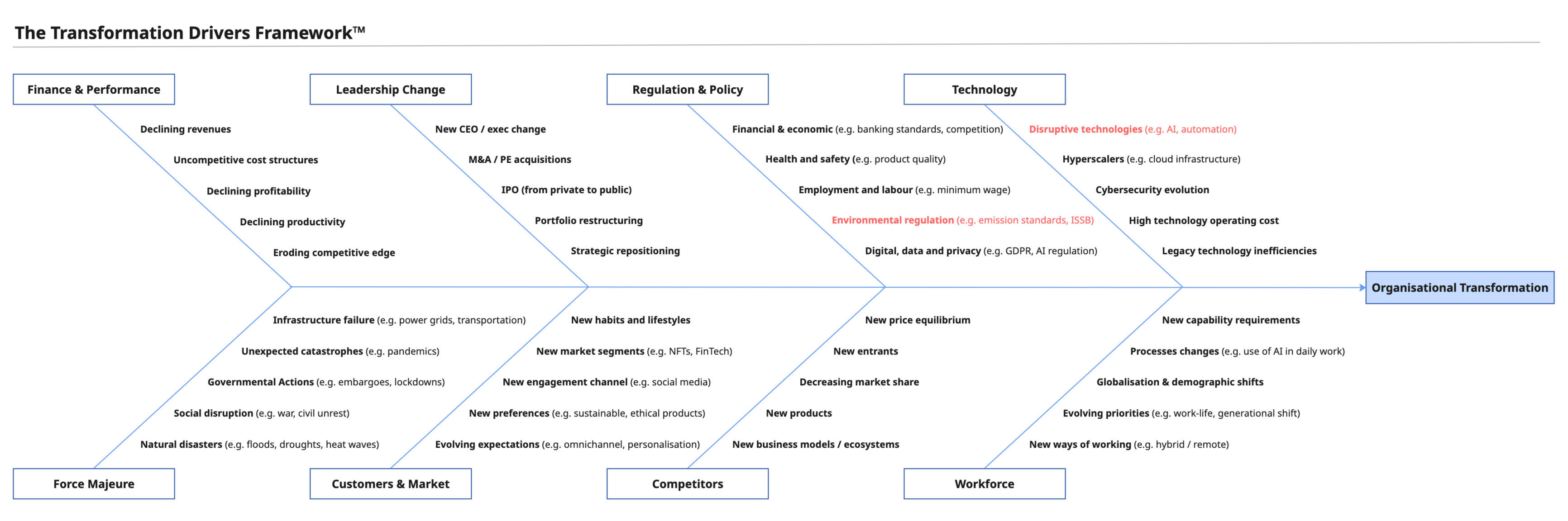
I would not claim this covers every single possible trigger, but it represents a significant portion of the key triggers. You will likely recognise some of the more familiar ones (highlighted in red), such as the impact of AI on the organisational ways of working, the challenges of sustainability reporting under frameworks like the ISSB, or the supply chains risks arising from conflicts, wars and embargoes, are just part of the story.Organisations use a more complex constellation of signals to decipher when and what to change.However, organisational transformations are rarely caused by just one trigger. A combination of 3–4 triggers simultaneously (such as technology disruption, customer expectations shift, new CEO strategy, and financial pressure) is necessary to create a transformation tipping point.Based on the insights from McKinsey & Company, Bain and Co, BCG, and the frameworks of Michael Porter, Clayton Christensen, strategic management frameworks, and PROSCI insights, we can begin to classify organisational transformations into a Four Transformation Archetypes.
The Four Transformation Archetypes
This model can help leaders answer the question: “Why is the organisation transforming?”Thus, triggers are categorised into the 4 most common archetypes of transformation tipping points (Exhibit 2):
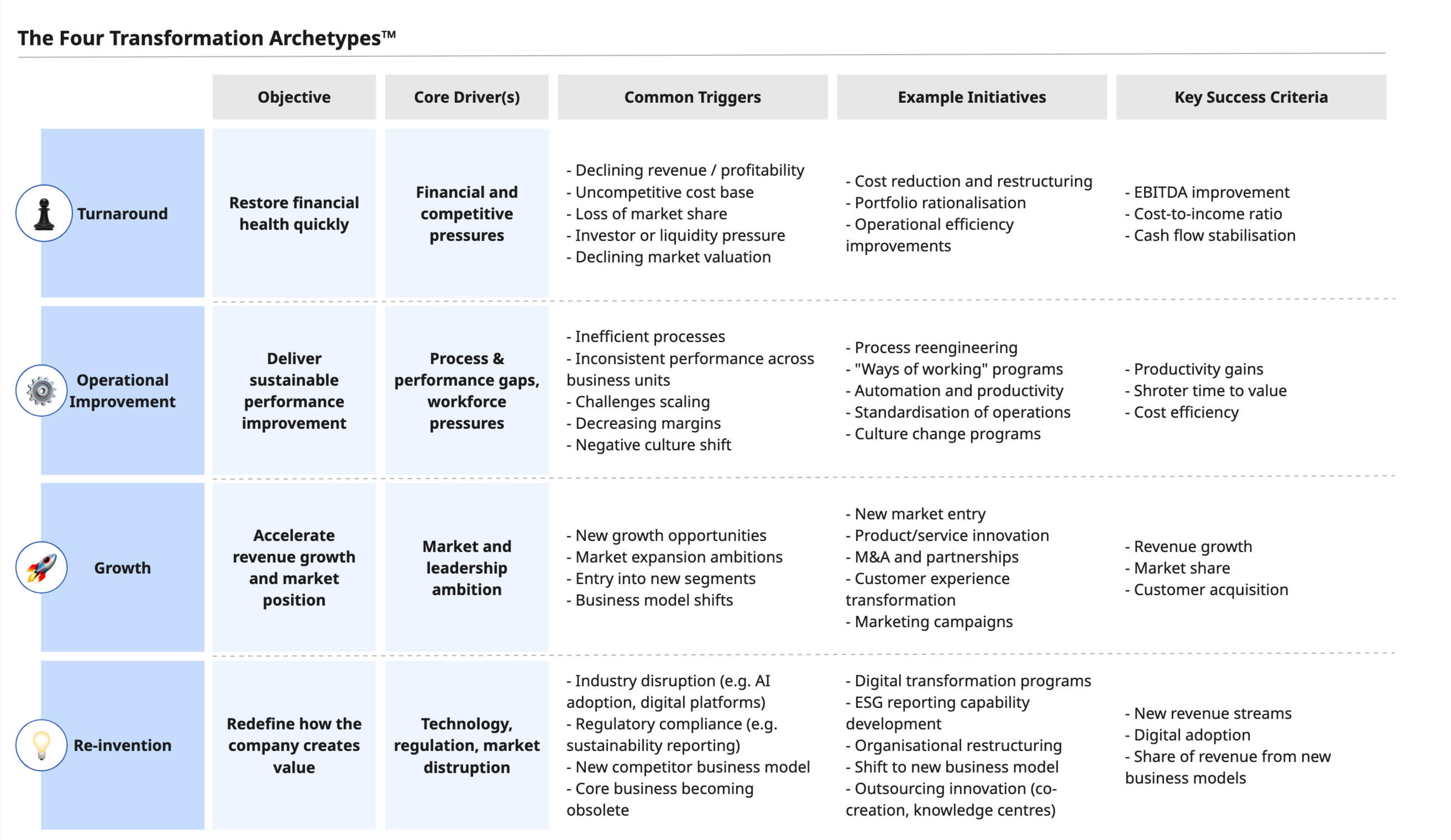
Note that this is a simplified model of transformation. Real transformations are multi-dimensional have multiple nuances. (More about this model in Disclosures, at the end of the article)1st — Turnaround. Organisational transformation to Fix the Business is often triggered by the financial and competitive pressures, such as low margins and decreasing productivity. The transformation is required to find a financial remedy fast and restore financial performance. Typical success criteria include KPIs that track financial health.2nd — Operational Improvement. Organisational transformation to Improve the Business is often triggered by gaps in performance, processes or workforce pressures, whereby the organisations is not operating at its full potential. Commonly, a transformation is required to improve the ways of working and close performance gaps to sustain competitiveness and meet business objectives.I have seen this challenge come up in some of my transformation work. For instance, a Telecom client was transforming their ways of working to improve time to market across borders while also aiming to reduce costs by around a third.3rd — Growth. Organisational transformation to Grow the Business is often triggered by the leadership ambition and market opportunities to expand either the product range, customer segments, geographical reach, improve product pricing, or all at once. This transformation is commonly characterised by new market entry campaigns, innovation and new product development, or new pricing strategies.I have seen this challenge in some of my work as well, such as during the long process of defining, founding and scaling a new corporate offering to meet the evolving client needs.4th — Reinvention. Organisational transformation to Reinvent the Business is often triggered by existential disruptions, such as technological advancements (e.g. AI), regulatory changes (e.g. sustainability mandates as a license to operate), or competitor or market disruption. Commonly, initiatives to address these shifts focus around moving the organisation to adapt to the new normal, such as investing in digital transformation, ESG reporting capabilities, and breaking silos in organisations for co-creation, alignment, and innovation.I have seen this challenge come up for a client as well, a global car manufacturer who was pursuing a core banking transformation to redesign the way they help their customers finance their car purchases.
Conclusion
The Transformation Drivers Framework™ and the Four Transformation Archetypes™ can help leaders understand:a) What is the root cause and what triggers are they witnessing in their organisation?b) How close are they to a transformation tipping point?c) And if they are already transforming, what archetype is the closest match and what initiatives might help meet their objectives?This is a quick and general analysis of the organisational transformation triggers and archetypes agnostic of industry or geography. A targeted analysis with a clear end-goal for a specific program or organisation can reveal much more insights into “why” and “what” needs changing (if anything).Furthermore, as the coauthor of the book ‘The Secret of Culture Change’ Jay Barney, the author of the book ‘Good to Great’, Jim Collins, the PROSCI body of knowledge on organisational transformation, and many other authors have noted, organisational transformation is underpinned by a cultural transformation.Without the people enacting the change, no amount of planning will, by itself, move the needle.
If you found this article insightful, follow for more. I write on adaptive organisations, strategy, leadership, and decision-making in high-pressure environments.
Disclosure
Exhibit 1, The Transformation Drivers Framework, strives to capture a significant portion of potential triggers by using brainstorming, MECE structuring techniques, and professional experience from myself and peers. Even so, it is possible that there may be many more transformation triggers that are not yet captured in this diagram. If you think I’m missing some, let me know!Exhibit 2, the Four Archetypes Model, is a synthesis of recurring transformation patterns observed across strategy literature and consulting practice, grounded in sources: McKinsey and Company, Bain and Co, BCG, Michael Porter, Clayton Christensen, strategic management frameworks, Lean / Six Sigma body of knowledge, and the PROSCI change transformation methodology.This model simplifies a very complex domain of organisational transformation that inherently has multiple nuances and dimensions, with the goal of helping leadership frame the problem quickly and align stakeholders with greater ease.It has 5 inherent assumptions: 1) all transformations are goal-driven, 2) a dominant driver exists, 3) transformations cluster into repeatable patterns, and 4) business model disruption is categorically different, 5) internal and external triggers can be abstracted.The strengths of this model are that it syntheses real transformation archetypes observed in practice, aligns with multiple well-established frameworks, and provides a clear and easy method for leaders to diagnose and communicate change.Weaknesses of this model include the potential for some transformation cases to straddle the boundary between growth and re-invention, as well as the fact that this model provides only a generalised view that does not account for industry specifics.It was created with the help of an AI agent who was instructed to act as a PROSCI certified change management professional with 20+ years of experience in the field. All of the points and assumptions made in this model were checked and tested to the best of my knowledge with my colleagues. If, however, you believe it can be improved further, I would be happy to hear your ideas!
9 Ways to Think More Clearly When Everything Is Changing
Two frameworks to identify triggers and decode the archetypes of transformation16th January 2026Have you ever been in a situation where you felt the ground was shifting beneath your feet?It could have been something as minor as having to change project teams or adjust your routine during a vacation, or as impactful as moving continents for a better life or managing a long-distance relationship.“Nothing is permanent except change” – Heraclitus.In these moments, we have a choice:a) Let the change overhelm usorb) Turn it into an opportunity for growthEighteen months ago, I was a management consultant at a boutique organisation, advising some of the world’s biggest brands on strategy and business transformation. At the same time, I founded and led the Sustainability Advisory branch, liaising with experts and heads of practice while rallying internal talent to meet our clients’ evolving needs.Life was moving at shinkansen speed.Last year, I chose to step off the train to pause and take in my surroundings.For a year, I travelled the world and explored the concepts of “happiness,” “success,” and “fulfilment” by learning from renowned authors, reading thought-provoking articles, and engaging in spontaneous conversations with passing strangers in the most mundane places.I quickly discovered that “success,” “fulfilment,” and “happiness” can take as many forms as there are people in the world.But most interestingly, it is how we define these concepts for ourselves that gives them their meaning and power.When we look back and assess our achievements over the years, we are predominantly evaluating if we have met our own goals, if our life fits our personal definitions of “success” and “happiness”, and whether we became the person we wanted to be.We define our parameters every day:
- Does “success” mean working 80 hours a week, or spending evenings with loved ones?
- Does “fulfilment” mean staying in your lane to secure a promotion, or taking a leap of faith to follow your dreams?
- Does “happiness” mean praise and recognition from friends and family, or inner peace and alignment with your values?Maybe it is not an “either-or”. Maybe it is a means to an end. But one thing is certain:When it comes to happiness, success, and fulfilment, I believe we are the ones accountable and responsible for making them happen. No one else is.Books such as The Four-Way Path by Héctor García and Francesc Miralles, Atomic Habits by James Clear, Zen: The Art of Simple Living by Shunmyō Masuno, and Lessons from Gin: Business the Four Pillars Way by Matt Jones, as well as professional development courses like the McKinsey Forward Program, have been fundamental in crystallising my understanding of my definitions of “happiness,” “fulfilment,” and “success.”Travelling provided the opportunity to apply these concepts in real life: by observing, understanding, and managing myself as a solo traveller, and by learning from the mesmerising lives of passing strangers, from tea houses in Kyoto to surf beaches in Sydney.Here are some tips and reminders to help you take a breath, pause, and observe what you can control. I am sure you already know most of them, but every once in a while, it feels good to be reminded.
1. Observe your Surroundings
Are you in a place that makes you feel good? How is the room temperature, the sound, the light? If there are people around you, are they enthusiastic or relaxed? What are they doing?Your environment plays a significant role in your wellbeing.Did you know that 15 minutes of midday sun, several times a week, stimulates vitamin D production, which helps strengthen immunity, increase bone density, boost mood, regulate your circadian rhythm, improve sleep efficiency, and even lower blood pressure? (Cleveland Clinic, 2025; Calm’s Editorial Team, 2024)Similarly, being near the sea can reduce stress responses, support lung health, boost mental wellbeing, and encourage physical activity. (Blue Zones, 2024; DEFRA, 2020) A large-scale study of 20,000 people and over one million real-time reports of happiness found that marine and coastal environments were consistently ranked as the “happiest” locations. (MacKerron and Mourato, 2013)That is why time spent outdoors feels so good. Go for a walk. Get some fresh air. It clears your mind more than you might expect.
2. Control your Breath
How we breathe sends a signal to our brain about whether we are in danger or at ease. In high-stress situations, controlling our breath helps us regain control of our mental state.One effective exercise you can do is the 4–7–8 breathing technique, rooted in the ancient yogic practice of pranayama and popularised by Dr Andrew Weil. Inhale deeply for 4 seconds, hold for 7, then exhale slowly for 8. As you breathe out, place your tongue against the back of your upper teeth and release the air gently, creating a soft “whoosh” sound. (Medical News Today, 2025; WebMD, 2023)This technique has been shown to promote relaxation and induce a calm state of mind, helping to restore clarity in stressful moments. (Rahmawati, 2025)Did you know that a study of 110 undergraduate students found that the 4–7–8 method helps improve sleep quality and reduce insomnia-related symptoms (Abdelfatah et al, 2019)? Furthermore, a study of healthy young adults found that even short sessions of 4–7–8 breathing after sleep deprivation increased HRV and lowered blood pressure, suggesting beneficial autonomic and cardiovascular effects in healthy young adults. (Prasetyo et al, 2022)This breathwork can be practised anywhere, anytime, even after a simulated hostile negotiation. Combined with other breathing techniques, it’s a powerful tool for remaining calm under pressure.The capacity of our lungs is key to longevity. Control of our breath is key to calmness. (García and Miralles, 2024)For more on this, feel free to explore topics from Andy Galpin, Andrew Huberman, Layne Norton.
3. Recognise your Triggers
First, pause. If you feel agitated or in a heightened state of stress, pause and identify what triggered your reaction.It could be a situation that made you feel undervalued, a comment that contradicted your beliefs, or simply feeling overwhelmed by current events.Common triggers in the workplace include workload intensity, job insecurity, interpersonal conflict (Bhui et al. (2016), workplace toxicity, role ambiguity, lack of control, or lack of supervisory support. (Sattar et al, 2024).Second, create space. Go for a walk, have a cup of your favourite drink, ground your feet on the floor, or practise the 4–7–8 breathing technique mentioned earlier. Distance yourself from the emotional charge of the moment.Third, reflect. What was the trigger? Why did it affect you? How might you work around it in the future?Four, anticipate. Anticipating your triggers helps you remain composed when they arise unexpectedly.Before a high-stakes meeting, for example, visualise potential uncomfortable scenarios and rehearse how you would respond with calm and grace.
4. Reframe your Mindset
Notice the mindset you are in right now.Are you in a resilient mindset, whereby you are open to learning, experimenting, innovating, and creating better outcomes?Or are you in a limiting mindset, whereby you are operating in survival mode, reacting impulsively, or being overly self-critical?In challenging situations, such as making crucial decisions under uncertainty and time pressure, it is easy to slip into a limiting mindset. Yet reframing how we interpret events can unlock better decision-making and higher productivity.For example:- From “Why is this happening to me?” to “What can I learn from this?”
- From “Why are they always critical of my opinions?” to “What might this person be experiencing that I’m unaware of?”
- From “Why do I have to do this unmotivating task?” to “How might this task align with my values or purpose?”The McKinsey Forward program distinguishes between 7 limiting mindstes and how to reframe them into resillient mindsets. For example, you might be in a “fixed mindset” whereby you perceive every challenge as a test that you have to pass or fail. To become more adaptable, you can shift to a “growth mindset” whereby you preceive every challenge as an opportunity to learn. (McKinsey.org, 2026)A small shift in mindset goes a long way. It’s not what happens to us that determines the outcome, but how we respond.
5. Manage Overthinking
“More things frighten us than injure us, and we suffer more in imagination than in reality.” — SenecaThe first step is noticing when you are overthinking. From there, you can apply proven strategies to manage it.1. Practice mindfullness by grounding yourself in the present moment. Observe your thoughts without engaging with them, and let them pass. This practice significantly reduces rumination and improves emotional regulation (Davis, 2024).
2. Schedule “Worry Time” by setting aside 15 minutes to intentionally focus on your concerns. When the time is up, let them go or defer them. (Astute Education and Psychology Centre, 2025)
3. Move your body. Exercise pulls your attention away from hypothetical scenarios and anchors you in the present. (Science News Today, 2025) Hit the gym, hit the track, go salsa dancing, play Padel, or any other physical exercise you enjoy.
4. Write them down. Seeing your thoughts on paper helps separate facts from emotions and often provides a clearer, bird’s-eye view (ZenCare, 2025).
5. Be kind to yourself. Replace downward spirals of “what could go wrong” with upward spirals of “what could go right.” Shame and anxiety are often the key factors fueling overthinking, which can be mitigated by self-compassion.You can even turn overthinking into preparation by asking, “If this happens, how will I respond?” Anticipation builds resilience.This is a common practice for atheletes, who employ visualisation technqiues during training and competitions to prepare mentally for performance day and develop comping mechanisms for any possible eventualities. This increases self-confidence, concentration, and reduces anxiety, as well as improves physical performance and motivation (Predoiu et al, 2020)
6. Choose your Identity
Observe your thoughts, beliefs, and assumptions. What limiting beliefs are you holding? (Briana, 2020) What story are you telling yourself about who you are? (Clear, 2018)You are what you repeatedly tell yourself. Your thoughts are the operating system, and you can reprogram them.For instance, if you have always believed you are a bad driver, that belief becomes part of your identity. But it can change. Small, intentional mental repetitions begin the rewiring process. Take 5min every morning whilst you’re sipping coffee, and you might repeat “I’m a safe driver” for 20 times. Believe it every time you repeat it. This will not magically make you a better driver, but it is the first step towards adopting microhabits that changes your behaviour.Your body also reinforces identity. Mind and body communicate continuously, creating feedback loops that shape behaviour.Training as a black belt in Taekwondo, I personally noticed this two-way communication between the body and the mind. What starts with a mental prompt becomes the body’s default operating system, which becomes a self-reinforcing loop.For instance, if you are training to become a runner, you start by setting a goal, devising a training schedule, and giving your friend £100 to keep should you fail to complete your training that week (depending on your friend, you might decide that peer-pressure or encouragement is a strong enough motivator).Over time, your muscles adapt to the new routine. Your might say it is because of habit, but you will also notice that on the days that you remain sedentary, your body starts “itching.” You might notice you start feeling uncomfortable if you don’t go for a run. This is where your body prompts your mind to keep training. At this stage, you have two forces pushing you towards your new identity: your mind and your body.Change is uncomfortable, and the first step is the hardest. But each small action compounds, building momentum and gradually forming a new identity.Choose your thoughts the way you choose your clothes every morning.
7. Acknowledge your Past
Our past shapes much of what we do, say, and feel.But it is also where our skills live, a repository of lessons that guide better decisions and self-understanding.When Thomas Edison was asked about his experience in creating the light bulb, he said “I have not failed 10,000 times. I have successfully found 10,000 ways that will not work.” (Smithsonian Magazine, 2013)If we are not brave enough to try 10,000 times, how can we discover that one breakthrough that leads to a brighter future?Traveling around the world, I found that past experiences have two dimensions: tailwinds and headwinds.Tailwinds are the lessons learned that propel us forward. For me, living in London for 10 years helped me navigate the complexity of Tokyo with unexpected ease. Or, promoting my Advisory services to clients helped me negotiate favourable leases for my 4 months stay in Sydney.Headwinds are the lessons learned that hold us back. The unnecessary baggage you bring to your new job, new relationship, or new phases of your life. George Clooney said this more eloquently in the movie “Up in the Air” (2009). For me, I learned to recognise that Fiji works very differently from London. Not least because of what locals call “Fiji time”, but also because the biodiversity of its marine life is at risk from climate change. An impact we rarely see in London.The challenge is knowing what to carry forward and what to leave behind.In the Four-Way Path, the authors cite a Budhist story that helps crystalise this concept (García and Miralles, 2024). It goes something like this:A monk was walking through a forest one day, and stumbled upon a river. The river was wide and strong. There was no bridge in sight. The monk worked day and night and built a raft. The raft held steadfast. The monk jumped on it and was able to cross the river.When the monk reached the other side, they had the strong urge to take the raft with them on land. To carry it on their back through sun and heat, because they worked so hard to build it.But, with humbleness, they realised that it would only weigh them down. The best option is to let the raft float down the river, so that it can help other people in need to cross.If an experience no longer helps you build your future, acknowledge it, and let it go.
8. Accept and Let Go
Once you identify what no longer serves you, release it.This may include expectations, preconceptions, the need for control, outdated beliefs, or unresolved emotions.Multiple research explored this topic. Yet one concept that has spoken to me the most is the idea of letting go of expectations, presented by García and Miralles (2024) in their book, “The Four-Way Path.”The expectation of what other people should say, of how someone should react, of how events should turn out, of how things should work. Additionally, I found we often have strongly-held preconceptions. Preconceptions of what the ideal job, the ideal partner, the ideal relationship, or the ideal location should be. When events don’t meet our expectations, or when our preconceptions are proven wrong, that is when we suffer.Letting go of expectations, about people, outcomes, and events, frees us from unnecessary suffering. When we stop insisting on how things should be, we can meet reality as it is. The concept of letting events be what they are is explored by the book “The Let Them Theory,” by Robbins and Robbins (2024).Shunmyō Masuno, in the book “Zen: the Art of Simple Living” (2019), introduces the concept of finding joy in the things we can control, rather than wishing for them to change. Finding joy in what we can control, from a morning coffee, a walk in nature, to a meaningful conversation, anchors us in gratitude and presence.That is one of the 100 ways to live a happier life, as presented by a Zen master.
9. Do What You Can in the “Here and Now”
What are you uniquely positioned to do, given your current circumstances?Say you are a traveler who finds themselves homesick in a foreign country. What can you do in the “here and now”?For me, living alone for 4 months in Sydney away from friends and family, I found myself homesick. However, what I realised is that rather than counting down the days until I come home, I should make the most of what Sydney has to offer. Not least of its stunning Blue Mountains and the Grand Pacific Drive, but also its people, its vibrant Vivid Sydney, and its closeness to incredible places like Japan, Singapore, New Zealand, Fiji, and Hawaii. By shifting my perspective, I found a thousand-and-one ways to enjoy every day, rather than wishing the days away.Say you are a professional pursuing your dream career but area facing obstacles. What can you do in the “here and now”?For me, building the Sustainability Advisory branch from scratch taught me that everything is an opportunity, once you start looking for it. Instead of focusing on the things I could not control, such as the client’s decisions, I focused on what I could control, such as authoring White Papers, building an expert team, and sharing tailored recommendations with industry leaders.The story about building a brand from scratch truly moved me. Namely, “Lessons from Gin: Business the Four Pillars Way” by Matt Jones. In the book, the co-founder of Four Pillers explores the team’s journey from conception to one of the most recognised craft gin brands in the world. To surmount obstacles, it was fundamental for the founders to have absolute conviction that their vision would work. They had to be the driving force behind their dream.If you are pursuing a goal and someone asks you “Have you done everything you can to achieve it?” what would your answer be?You may discover a thousand-and-one ways to move closer to your goal, if you start looking.
Conclusion
If life is an ocean, you not only decide where to steer your ship, but also, how to make life on your ship a good one.For yourself, and for everyone sailing with you.When the storm comes, it is an opportunity to become a better sailor, by rolling up your sleeves and geting work done one rope pull at a time.
If you found this article insightful, follow for more. I write on adaptive organisations, strategy, leadership, and decision-making in high-pressure environments.
Disclosure:
The views of this article are solely my own, based on my experience and my interpretation of the research cited.AI was used in this article only for the purposes of: fact-checking, finding publicly-accessible academic research that prove or disproving claims, and for checking grammatical accuracy. AI was not used for anything ourside that remit. All facts the AI generated were checked and corrected according to their original sources, to the best of my ability.
Sources
Abdelfatah, A. et al. (2019) ‘Effect of the 4‑7‑8 breathing technique on sleep quality in undergraduate physiotherapy students’, Majalah Ilmiah Fisioterapi Indonesia.
Bhui, K. et al. (2016) ‘Perceptions of work stress causes and effective interventions in employees working in public, private and non-governmental organisations: a qualitative study’, BMJ Open, 6(11), e012973.
Blue Zones. (2025) ‘How time spent near water enhances our health’, BlueZones.com, Blue Zones LLC, Minneapolis, MN
Cleveland Clinic. (2025) ‘How much sunlight you need each day’, Cleveland Clinic Health Essentials, Cleveland Clinic, Cleveland, OH.
Calm Editorial Team. (2024) ‘What are the benefits of sunlight on physical & mental health?’, Calm Blog, Calm.com, San Francisco, CA
Clear, J. (2018) Atomic Habits: An Easy & Proven Way to Build Good Habits & Break Bad Ones. Avery.
Davis, M. (2024) ‘Overthinking and rumination: how to quiet your mind and find peace’, Feel Better Therapy
Department for Environment, Food & Rural Affairs (DEFRA). (2020) The social benefits of blue space: a systematic review, DEFRA, London.
Health.com Editors. (2024) ‘I spent 15 minutes in the sun every day for 30 days’, Health.com, Dotdash Meredith, New York, NY.
Hendry, E. R. (2013) ‘7 epic fails brought to you by the genius mind of Thomas Edison’, Smithsonian Magazine
Garcia, H. and Miralles, F. (2024) The Four-Way Path: The Evergreen Guide to Ikigai Living. Penguin Life.
Jones, M. (2024) Lessons from Gin: Business the Four Pillars Way. Wiley.
MacKerron, G. and Mourato, S. (2013) ‘Happiness is greater in natural environments’, Global Environmental Change, 23(5), pp. 992–1000.
Masuno, S. (2019) Zen: The Art of Simple Living. Penguin Life.
Medical News Today. (2025) ‘4–7–8 breathing: How it works, benefits, techniques, and uses’, Medical News Today, Healthline Media, San Francisco, CA.
Prasetyo, A. et al. (2022) ‘Effects of sleep deprivation and 4‑7‑8 breathing control on heart rate variability, blood pressure, blood glucose, and endothelial function in healthy young adults’, Physiological Reports.
Predoiu, R. et al. (2020) ‘Visualisation techniques in sport — the mental approach of the champions’, Discobolul — Journal of Physical Education, Sport and Kinetotherapy, (49), pp. 48–55
Rahmawati, D. et al. (2025) ‘Exploring 4‑7‑8 breathing for stress relief and improved quality of life: a scoping review’, ICISTECH Journal.
Sattar, R., Lawton, R., Janes, G. et al. A systematic review of workplace triggers of emotions in the healthcare environment, the emotions experienced, and the impact on patient safety. BMC Health Serv Res 24, 603 (2024).
Science News Today (Aug 11, 2025) ‘How to stop overthinking right now: evidence-based strategies’, Science News Today
WebMD Editorial Team. (2023) ‘What to know about 4–7–8 breathing’, WebMD, Atlanta, GA.
Wiest, B. (2020) The Mountain Is You: Transforming Self-Sabotage Into Self-Mastery. Hay House.
Wright, J. (2025) ‘The overthinking trap: how to stop ruminating and find clarity’, Astute Education & Psychology Centre
Zencare Blog (Nov 3, 2025) ‘Stop rumination strategies’, Zencare
Six Types of Organisational Transformation Every Leader Should Know
A practical view of transformation domains and their 48 initiatives
2nd April 2026Organisational change is as much about understanding where you come from as it is about knowing where you are going.But most importantly, it comes down to knowing how to get there.My previous article explored the drivers of change and the archetypes of transformation, offering a structured lens to support clearer thinking and sharper conversations around how organisational transformation begins.This article builds on that foundation. It explores the directions of change, presenting a comprehensive view (Exhibit 1) of the most commonly observed types of organisational transformation and their associated initiatives.
THE FRAMEWORK — The Organisational Transformation Framework™
The Organisational Transformation Framework™ outlines 6 dimensions of change and 48 associated initiatives.It is structured using the rigour of a logic tree, with branches that are mutually exclusive and collectively exhaustive (MECE), and is further informed by AI as a supporting layer to enhance depth and breadth of industry insight.
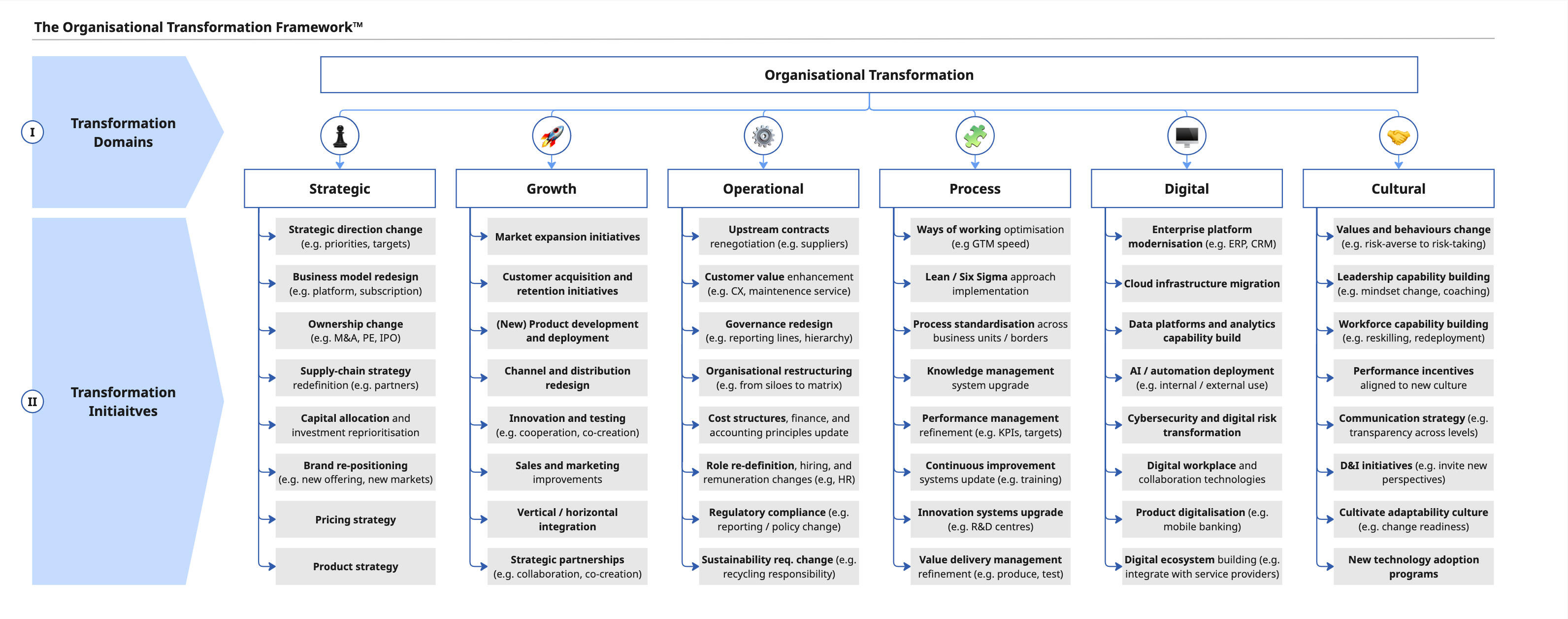
The challenge with mapping organisational transformation is the lack of a clear consensus on how it should be structured (in other words, what constitutes a single source of truth). Existing frameworks tend to structure transformation by impact, complexity, or the underlying drivers of change(PROSCI, HBS, IJECM).This framework employs a first-principles approach, offering a structure for organisational transformation based on the types of initiatives most commonly observed in practice.1st — Strategic Transformation.Initiatives that redefine what the organisation does fall under strategic transformation, whereby the top management team defines the direction or travel and the objectives to be met.This includes initiatives such as redefining the business model or rethinking supply chain partnerships in response to environmental or geopolitical shifts. A well-known example is Netflix, which evolved from a DVD-by-mail rental service into a global streaming platform.2nd — Growth Transformation.Whereas strategic transformation sets the direction, growth transformation focuses on execution.For example, where a strategic initiative defines a new ecosystem of partners in response to supply chain disruption, a growth initiative might involve vertical integration across suppliers. This can help increase control over the supply chain while improving operational efficiency and reducing costs.3rd — Operational Transformation.The way an organisation operates determines how agile and competitive it is on the market, as well as how quickly it can identify and respond to change. It also influences how successfully strategic and growth initiatives are executed.Jim Collins in his book “From Good to Great” provides a great example of how talent management shapes an organisation’s ability to navigate change. Prior to banking deregulation in the US, Wells Fargo, under the stewardship of Dick Cooley, rethought its approach to hiring and retaining talent to ensure it had the right capabilities to navigate future shifts.As a result, Wells Fargo outperformed its peers during deregulation, achieving returns three times higher, while its sector of the banking industry fell 59% behind the general market.4th — Process Transformation.Processes define how work flows and are effectively the organisation’s default operating system. They are often executed automatically, without intentional direction, which can either work in the benefit or to the detriment of strategic goals. Initiatives aimed at improving processes focus on how the organisation operates “under the hood,” enabling greater speed and efficiency.For example, one client I worked with was pursuing an initiative to standardise ways of working across seven business units in different geographies, with the aim of reducing time to market and lowering costs. Such initiatives not only benefit the organisation but also its customers, who ultimately gain from more reliable broadband services at home and abroad.5th — Digital Transformation.In recent years, digital transformation has become almost synonymous with organisational transformation, as the current rate of technological change has been consistently faster than the rate at which organisations can adapt to it.Digital initiatives can improve operational efficiency (such as through automation, AI-enabled workflows, or enhanced cybersecurity), as well as create customer value (for example by offering digital products such as mobile banking, bridging the physical–digital divide, or enabling on-demand services.)6th — Cultural Transformation.People are at the centre of any organisational transformation, a point echoed by PROSCI, as well as firms and authors involved in transformation work (such as McKinsey & Company and Jay Barney).Much of the heavy-lifting often lands on the shoulders of leaders, who are responsible not just for driving change, but also modelling it. This includes understanding how to move individuals from resistance, to acceptance, and ultimately to thriving in a new environment.For example, the impact of culture on company success is conveyed by Jim Collins. When faced with competition from Procter & Gamble (P&G) in the paper-based consumer business in 1960s, two incumbent companies in the same industry with similar financials, Scott Paper and Kimberly-Clark, responded differently.Whilst Scott Paper “resigned itself to second place”, Kimberly-Clark saw this competition as an asset. Under Darwin Smith’s leadership, the team fostered a culture of continuous improvement and a winning attitude, framing this challenge as an opportunity to make the company greater.Despite operating in the same environment, different cultures and different leadership led to diverging outcomes. Under Darwin Smith’s stewardship, Kimberly-Clark generated cumulative stock returns of 4.1 time the general market, owned Scott Paper, and outperforming P&G in 6 of 8 product categories.
PURPOSE
In practice, transformation efforts are often discussed in fragmented terms (whether digital, operational, or cultural) without a clear view of how they connect. For example, departments may pursue their own transformation initiatives, with varying degrees of coordination with other departments or alignment to a unified corporate direction.This framework is intended to bring these transformation elements into a single, coherent view. It is not designed to be exhaustive, but rather to offer a practical lens that can be applied across different transformation contexts. As with most frameworks, its value lies in how it is applied, adapted, and challenged in practice.It aims to provide a clearer view of transformation scope, help locate where initiatives sit, and support alignment across complex programmes.
APPLICATION
The framework is designed to be a practical tool that can be used to:
Frame transformation scope at the outset
Map existing initiatives across domains
Identify gaps or overlaps
Support leadership discussions on priorities
It is worth noting that it is not intended to be a replacement for detailed programme design, rather a way to bring structure and coherence to complex transformation efforts.
CONCLUSION
Transformation is often complex and systematic, requiring coordination across the entire organisation to make it a success. It is rare for organisations to pursue just one type of transformation at any given moment, which is why it is crucial to have an eagle’s eye view of every single initiative and where they fit.This framework can make it easier to understand exactly this. Namely, what is changing, why it is changing, and how the different elements connect.
If you have been involved in transformation efforts, what do you think?Does this structure reflect how transformation plays out in practice?What would you would add, challenge, or refine?If you found this article insightful, follow for more. I write on adaptive organisations, strategy, leadership, and decision-making in high-pressure environments.
Three Steps CEOs Can Take to Turn Urgency into Real Change
How to avoid 6 months of stalled momentum using Kotter’s 8 steps model16th April 2026The CEO declares: “We must change otherwise we perish!”They create emotional urgency, imbue employees with a sense of action, make change feel inevitable.Six months later? Business as usual.What went wrong?This challenge might sound familiar.Creating urgency is just the beginning of organisational transformation. What happens after defines whether change becomes a reality that endures or a message that fades.I found it useful to draw on both my experience and John Kotter’s 8 step model to understand where change breaks down and what can be done to fix it.With 6 months gone and business confidence falling, there is no time to waste.
THE FRAMEWORK — Kotter’s 8 Steps Model
John Kotter’s 8 Steps for Leading Change incorporates key lessons from decades of observing organisational transformations, capturing the common success criteria into 8 steps.When a CEO creates a burning platform, they declare an existential crisis where the cost of inaction is greater than the cost of change. This is just the beginning, namely step 1 of 8.However, most transformations break down between steps 2 to 4, long before anyone sees visible change.Here is a high-level summary of steps 2 to 4 of Kotter’s model:Step 1 — Create urgency. Done, but there is a catch: There is a difference between fear-based urgency (“we are dying”) and opportunity-based urgency (“this is what’s possible”). Fear can paralyse people rather than mobilise them. It is worth asking: “Did people believe the platform was truly burning, or did they think the CEO’s speech was only dramatic?”Step 2 — Build a guiding coalition. This is often a failure point. A CEO cannot drive transformation alone. If no senior cross-functional group was formed and empowered to lead the change, the urgency had nowhere to land. Middle managers, the real transmission layer of any organisation, never got activated.Step 3 — Form a strategic vision. Urgency without direction is just anxiety. If the CEO said why things must change but not what the future looks like, people freeze. “We must change” is not a vision. “This is what we are becoming and why it is worth it” is.Step 4 — Communicate the vision. Even with a vision, if it was communicated once (town hall, all-hands email) and never reinforced, it evaporated. Kotter says leaders under-communicate vision by a factor of 10. One speech is not a communication strategy.Steps 5 to 8 (removing obstacles, generating short-term wins, sustaining acceleration, instituting change) often do not get a chance to operate if 2 to 4 are broken.
APPLICATION
The model helps us gain a clearer picture of where challenges normally arise in the first few months of implementing change, as well as what questions we should be asking to uncover potential inefficiencies.Now that we have a rough idea of where to look, we can go back to our case where the CEO created a burning platform, and check whether any one of these challenges are present in their change programme.A good diagnostic conversation usually involves these questions:1. “Who else, besides you, was responsible for leading this change?”If the CEO hesitates, names no one, or says “my HR director was coordinating it”, it is highly likely that change broke down at step 2. No guiding coalition means that the leadership team did not act on the urgency for change.In contrast, if the CEO has a solid coalition in place, it is already a good start. However, they may still have blind spots. They may have a coalition, but how empowered or committed is the coalition truly? Are those people leading the change, or coordinating it?2. “What were you trying to get people to move towards?”How a CEO answers this question tells you as much as what they answer.A compelling vision should be articulated in under 60 seconds. It should be emotionally resonant, and specific enough that employees can make decision against it on a daily basis. If the CEO has a strong answer, then vision clarity is likely not the challenge.However, if the CEO takes three minutes, uses abstract jargon, or describes a process rather than a destination (“we are implementing an agile transformation”), this already reveals a potential challenge. If this is the case, then a lack of vision clarity is what prevents change from happening.3. “How often was change communicated? And by whom?”An effective communication strategy takes everyone on the journey towards the desired state, creates engagement at throughout the organisation, and tailors change as an opportunity for growth for everyone involved.In contrast, if there is no clear communication strategy, if it is fragmented or confusing, and different people tell you different things about what the direction is, this is likely the cause for stalling change.4. “What would you have done differently?”This reframes challenges into lessons learned, thus inviting collaboration, candour, and constructive analysis of what went wrong with a focus on how to fix it. It is essential for the CEO and leadership to take a pragmatic and thorough introspection to drive change in the right direction.Caveat: this can be a sensitive topic, especially if the question is framed more bluntly like “What challenges do you face?” A question that requires leaders to locate failures within themselves or their decisions can lead to defensiveness, since it triggers reputation protection.Emotional intelligence matters just as much as a factual approach.
RECOMMENDATION
There is a real risk of designing the perfect system while momentum bleeds out. Not to mention constraints like resources, politics, and time rarely let you do everything at once.For a CEO that has lost six months and organisational confidence, regaining momentum through small, rapid wins might be a priority.In comparison, for a CEO that wants to enter an innovation-drive market, the priority might be to design an accurate plan to shift the organisational culture from risk-averse to risk-taking in a structured way.Therefore, there is considerable nuance when recommending a change approach. The recommendation depends on a variety of factors, including:
Does the CEO have a clear understanding of what the opportunity is?
What has been the company’s history of change? What attitudes do they have towards change?
If a change programme is underway, where has it broken down?
What is the priority for the next 30 days? Is it quick wins, regaining momentum after six months of stalling, or is it creating a coalition?
What kind of change is being implemented? What are the core levers driving that change (cultural shift, digital transformation, market expansion?)
It is worth noting that there is also the cost-of-wrong-direction.I have seen this play out in real life, where it is more costly to drive in the wrong direction and then try to adjust course, than to take thirty days upfront to choose a good direction and then drive at full speed.Thirty days of planning might feel slow. But six months of misaligned effort, which is what happened to the theorised CEO, is far more expensive.Having said that, if I were to prioritise 3 steps that leaders should take to turn urgency into real change, I would recommend the following:
1st — Clarify the future state.
When leaders create a burning platform, they must also be clear on what the opportunity is behind that urgency and be pragmatic about what it would take to get the entire company there. This brings vision clarity (step 3) right to the forefront.This sequencing may be unconventional, since it is hard to enact change without political buy-in, but it has its strength. Having vision clarity sets the North Star for the organisation, the culture, and the coalition that they should aim towards.Jim Collins argues that good to great companies first get the right people on the bus, the wrong people off the bus, and the right people in the right seats, before they decide on a direction.However, in my experience I found that when you are making that choice about people, you already have a rough vision about the purpose of that bus. That rough vision is what guides your selection process. Next is to get the people that can challenge, shape and sharpen your vision and devise a path to get there.
2nd – Build the informal communication
To make change real, create stories to build momentum and shift behaviour. The way information flows through the company is two-fold:a) formal (forums, announcements, all hands meetings, emails)b) informal (coffee chats, stories, culture, behaviours).Informal communication shapes what people see as acceptable behaviour, guides decision-making at all levels, and is what kicks in when there are no formal rules governing certain situations.The organisation that wants to change needs to master both.Firstly, they need to create stories that support the future state. For example, say a CEO of a siloed organisation wants to make it more collaborative. One way to do this through informal communication channels is for them to act to actively break silos.This one action becomes a story that travels through the organisations. Three of these actions create a narrative, and the organisations starts to see that breaking silos is the new normal. This is how culture shifts. (Jay Barney explores this topic further here)Only after these stories are circulating, does the CEO need to launch an official communication strategy to strengthen this narrative of change.The key is to keep both channels of communication pointing in the right direction. Once one of them eases, momentum drops, and the urge to revert to the old ways becomes stronger.
3rd – Embed accountability
On top of establish a guiding coalition with a clear directive, it helps to establish a mechanism by which you hold this coalition accountable for implementing the change.Consistent with a portfolio management approach, this includes defining key deliverables, setting milestones, following roadmaps, and establishing alignment meetings to track and measure progress and surface any obstacles.This drives real results and ensures plans are acted upon with consistency and deliberation.
REALITY CHECK
This sequence of vision → stories → coalition works well when the CEO has genuine credibility and the organisation still has trust in leadership.It works less well in low-trust environments, where people have seen big visions announced before with little follow-up. In those contexts, the story must come before the vision. Leadership must make visible, unexpected actions that signal “this time is different”, otherwise the vision announcement is not acted upon.This is sometimes called the credibility gap problem, namely the bigger the past failures, the more emphasis needs to be placed on behaviour compared to communication.
CLOSING THOUGHT
Every transformation is unique. Different leaders will have different challenges that require different solutions. The deeper we dig, the more complex this becomes.There is, however, one certainity.To turn urgency into real change, leaders must balance between:
– Confronting the brutal facts (the burning platform)
– Maintaining a strong vision for how they will prevail (the change programmes)
If you found this article insightful, follow for more. I write on adaptive organisations, strategy, leadership, and decision-making in high-pressure environments.
DISCLOSURE
This was a case study exercise done in partnership with AI.AI has been used as a sparring partner only, running the simulation and asking me follow-up questions so that I can dive deeper into this topic.The framework application, insights, and recommendations in this case study are all my own thinking and judgement.
How Can LEGO Integrate GenAI into its Ecosystem?
A practical view on where generative AI fits across products, platforms, and experiences30th April 2026Digital transformation is as much about adopting new technologies as it is about aligning them with your brand identity and customer valueLEGO has the physical “brick” at its core. It engages both children and adults in creating tangible builds, inviting them away from the digital world and into the physical.So how can a superbrand that’s become synonymous with physical play navigate the age of AI, where experiences are increasingly virtual?
STEP 1 — Framing the opportunity
LEGO has already integrated digital technology into its value proposition. From expanding into digital platforms like LEGO Ideas, to producing LEGO Fortnite, releasing LEGO movies, and introducing the Smart Play System that bridges the physical–digital divide.Implementing GenAI features will require a careful balance between innovation and identity.This is not just a question of “How do we build GenAI?”, but rather: “How can this technology reinforce the LEGO values most at risk, namely imagination and creativity?”Deconstructing this challenge into a MECE structure (Exhibit 1), here is one way to frame the opportunity LEGO faces:
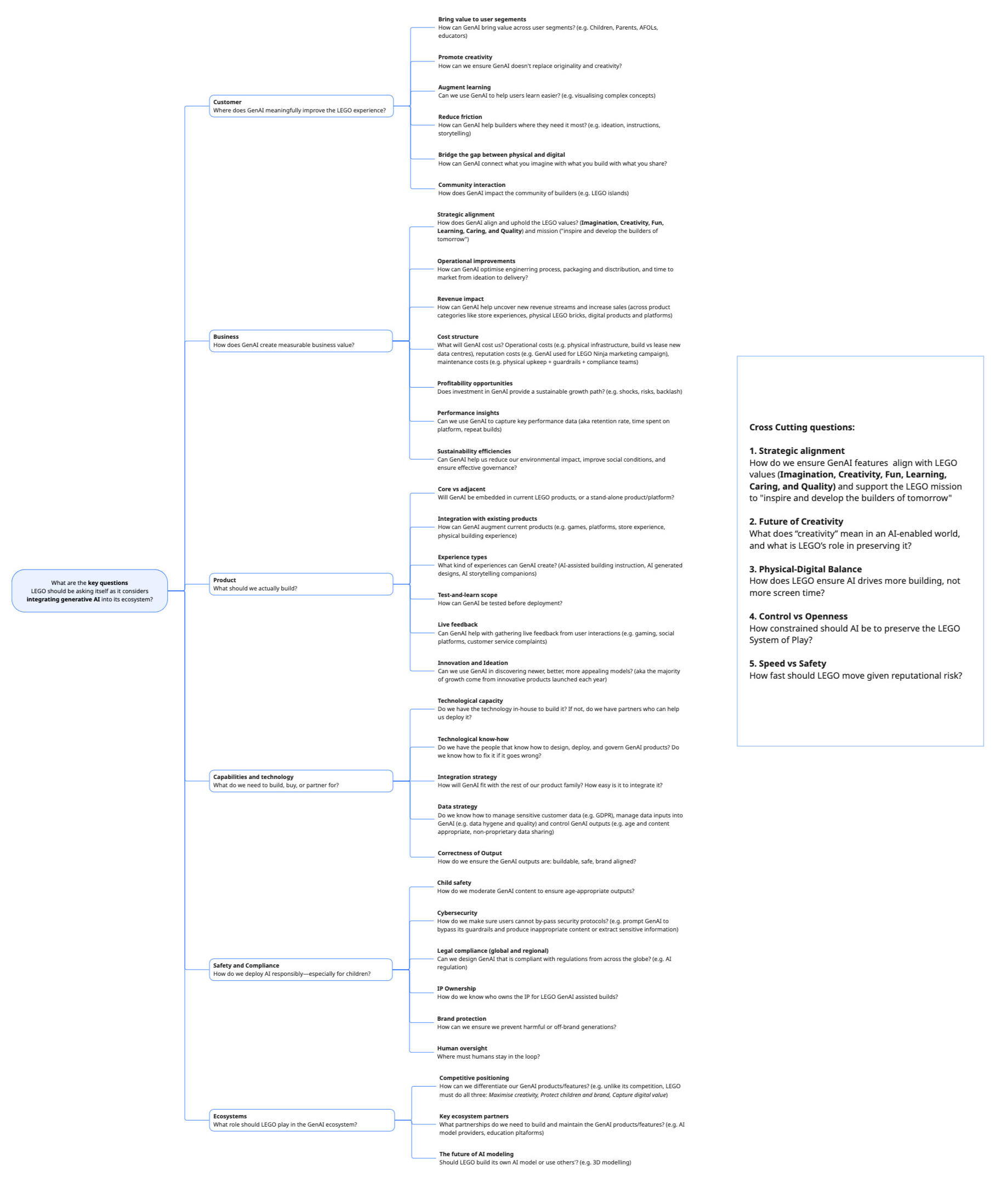
Exhibit 1: Key Questions for LEGO when integrating GenAI (by author)That’s a busy diagram. Precisely the point: applying AI within an established global brand, especially one rooted in the physical world, is inherently complex.Let’s break it down.LEGO operates across six dimensions affected by AI, prioritised below along with their key considerations:
1st — Customer
How does GenAI meaningfully improve the customer experience?This sits at the core of LEGO’s value proposition: deepening engagement with builders, enhancing creativity, and bridging physical and digital play.Key questions include:- How do we define creativity in the age of AI?
- Who owns the intellectual property of AI-assisted creations?
- How do we ensure children continue to think independently and creatively when equipped with such powerful tools?The answers form the foundation of the brand itself.
2nd – Business
How can GenAI create measurable business value?Once customer value is clear, the next challenge is operationalising it. This opens opportunities to enhance efficiency and generate deeper insight into customer preferences and unmet needs.Key questions include:- How can GenAI drive both operational efficiency and strategic advantage?
- What are the financial and sustainability implications of deploying AI?
- Where can we build and sustain competitive advantage?Positioning the business to capture this value becomes the second building block of LEGO’s digital transformation.
3rd – Product
What should we actually build?With customer needs defined and business alignment established, the focus shifts to product.Key considerations:- How will GenAI-powered features integrate with the existing portfolio?
- How do they reinforce core values (creativity, learning, and social interaction)?
- Can GenAI accelerate the design of new builds and experiences?This is where strategy translates into tangible outcomes. This is where ideas become products that drive both brand and business value.
4th – Capabilities and Technology
What do we need to build, buy, or partner for?This is the execution layer. If earlier steps define the “what” and “why,” this defines the “how.” In other words, now that we have designed the blueprint of the car we want to build and defined its purpose — how do we actually build it?Key considerations:- Do we have the required capabilities in-house?
- Which partnerships are critical to delivery?
- What feedback loops and controls are in place to identify issues early?Clarity here determines both feasibility and speed to market.
5th – Safety and Compliance
How do we deploy AI responsibly, especially for children?Say we built the car. But is it safe to drive?LEGO serves not only adults but also children, raising the bar for responsibility.Key considerations:- Do GenAI products meet safety, ethical, and regulatory standards?
- How do we ensure age-appropriate, brand-aligned outputs?
- Where must human oversight remain in place?This dimension anchors innovation firmly within the brand’s values.
6th – Ecosystems
What role should LEGO play in the AI ecosystem?Now that we have created the mechanism for building the car and have deployed it to our users, what does that say about us? This is a fundamental question about how LEGO shapes, and is being shaped by, the evolving AI landscape.Key considerations:- How will GenAI offerings compete over time?
- Which partnerships are essential for long-term relevance?
- How can capabilities (3D modelling with AI) extend into adjacent industries such as manufacturing or the built environment?This is where LEGO defines its role on GenAI not just through products, but through the relationships it forms, and the capabilities it contributes.
STEP 2 — GenAI Products and Features
Questions are useful to frame the problem, but they must lead to tangible outcomes.Building on what LEGO has already achieved, here are the GenAI products and features that are likely within reach (Exhibit 2):
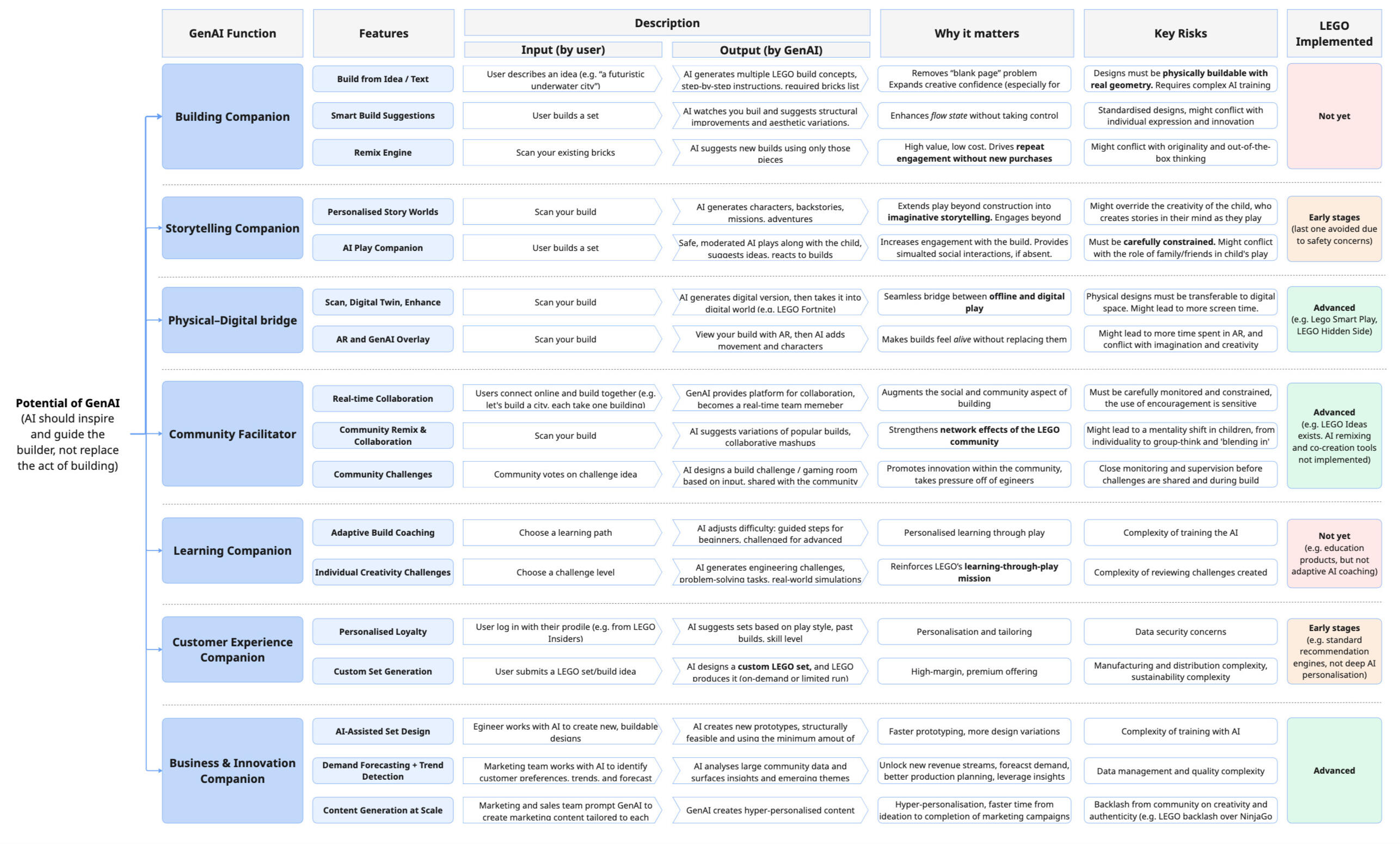
Exhibit 2: Potential GenAI Agents and Features for LEGO (by author)Again, that's a complex diagram. And rightly so. Even with LEGO's constraints, there are a wealth of possibilities for AI innovation. But each opportunity carries risk and requires deliberate controls.Here's what's possible.In the age of AI agents, it is useful to frame innovation around the roles these agents can play. First, define the role. Then, identify the features that enable it:
i. AI as a Building Companion
Imagine you want to build an underwater castle but have limited bricks and no clear starting point.An AI companion could analyse your available bricks, generate a buildable design, identify missing pieces, and provide step-by-step instructions tailored to your skill level.This addresses the “blank page” problem, supports creative flow without taking over, and optimises the use of existing bricks without new purchases. LEGO has already taken steps in this direction with LEGO Builder, which offers digital 3D instructions.The core challenge lies in ensuring that AI-generated designs are physically buildable within LEGO geometry, which requires highly specialised training. The risk: over-reliance on AI could unintentionally constrain creativity and imagination. Hence such features should be handled carefully.LEGO is in early stages of developing these features, based on what is known to the public, and herein lies an opportunity for future development.
ii. AI as a Storytelling Companion
Consider what happens after a build is complete. You spent half a day building a castle for your princess and her knight. Now what?With an AI storytelling companion, play can continue beyond construction. Using Augmented Reality (AR) or Virtual Reality (VR), children could scan their creations and unlock dynamic narratives, such as stories, characters, and adventures layered onto the physical build. This is what LEGO Hidden Side has introduced in 2019–2020.The biggest risk, however, is that it might increase screen time for children as well as hinder creative thinking when children create their own stories in their mind as they play. Such stories are essential for out-of-the-box thinking and originality when growing up.LEGO is in early stages of developing this category of features based on what is publically known. What’s more, the AI playing companion has been stopped in development because of privacy and safety concerns.
iii. AI as a Physical-Digital Bridge
The previous example bridges the Physical-Digital gap by adding virtual stories to the physical build.This a long-standing ambition. LEGO has launched LEGO Smart Play System in March 2026, introducing “smart bricks” that respond with sound and light in response to how children play with them. The common criticism with this technology is that children are already quite adept at making realistic sounds and special effects as they played.Another way AI can bridge this gap is by enabling you to take what you have built into your video game (e.g. LEGO Fortnite). For example, say you have built a robot in the physical world. Theoretically, you could then scan the robot and tell the AI agent to transfer it into your LEGO Fortnite video game adventure for you to interact with it digitally.The biggest challenge here is translating physical geometry into the digital world and then gamifying it on the spot. This requires extensive AI processing. It also leads to the risk of increased screen time.LEGO is already advanced on this front, as evidenced by products like LEGO Smart Play System released in March 2026 and the LEGO Hidden Side active between 2019–2020, where users scanned their builds to reveal a digital world of ghosts and could be solved by manipulating the physical bricks.
iv. AI as a Community Facilitator
Imagine building a shared world with your friends and family across different locations. Platforms like LEGO Builder and LEGO Play already enable collaborative creation. AI could extend this by acting as a facilitator, offering prompts, suggesting improvements, and supporting group dynamicsHowever, this introduces questions around privacy, data security, and autonomy. There is also a risk of over-facilitation, where AI dampens genuine human interaction.LEGO is already advanced on this front, as evidenced by platforms like LEGO Ideas where users can submit their design ideas or vote for their favourite build for a chance for that build to become a real product.
v. AI as a Learning Companion
AI could personalise learning journeys for builders of all levels.Beginners might receive structured progression paths, while advanced users could be challenged with increasingly complex builds tailored to their interests (e.g. Architecture, Star Wars, Botanicals).The difficulty lies in scaling personalisation across millions of users, which requires deep insight into preferences, behaviour, and even existing brick inventories so that AI can recommend builds based on the bricks they have.While LEGO has invested heavily in educational products, such as LEGO Education to foster STEAM skills, fully adaptive AI coaching remains an emerging capability.
vi. AI as a Customer Experience Companion
Internally, AI agents can help teams better understand their customers.By analysing purchasing patterns, store analytics, digital interactions, and engagement data, AI can surface insights into customer needs, pain-points, and opportunities for value creation.The challenge is to avoid shallow generalisations, labeling, and categorisation of users. True value comes from extracting nuanced insights, such as context, intent, and underlying drivers, not just trends.This remains an area of active development for LEGO.
vii. AI as a Business and Innovation Companion
GenAI can also augment other departments.Designers could use 3D modelling with AI to generate and iterate on new designs, while business teams could leverage it to identify trends, forecast demand, and shape strategy.The technical hurdle remains significant: generating designs that adhere to LEGO geometry and physical constraints is far from trivial. Nonetheless, experimentation (e.g. text-to-build tools) is already underway, such as LegoGPT or BrickItApp.This is one of LEGO’s strongest positions, particularly given its potential spillover into adjacent industries like construction and manufacturing.
REALITY CHECK
LEGO must balance GenAI innovation with its core values.Unlike its competitors, LEGO must pursue all three simultaneously:- Capture digital value
- Maximise creativity
- Protect children and brandShort term: Customer experience is the most immediate opportunity. Applying AI to better understand users and personalise offerings can unlock near-term value.Medium term: AI-driven storytelling offers a compelling avenue, provided content quality and brand alignment are tightly controlled.Long term: Building and learning companions represent the most transformative potential. However, they also carry the greatest technical and ethical complexity.Ultimately, the decision rests with LEGO. The path forward depends on a variety of factors, including which features they prioritise, the capabilities they have in house, and the strength of external partnerships.
CLOSING THOUGHT
The evolving ethical, privacy, and regulatory landscape around GenAI makes transformations like this inherently challenging.It is inspiring to see LEGO, a global brand whose beating heart is the physical experience, innovate extensively in the digital space without loosing sight of their core values.Much of the foundation is already in place - hardware (e.g. Smart Play), platforms (e.g. Ideas), and digital experiences (e.g. Fortnite). The next step is to build the intelligence layer that connects these elements into a cohesive ecosystem.
If you found this article insightful, follow for more. I write on adaptive organisations, strategy, leadership, and decision-making in high-pressure environments.
DISCLOSURE
This is an independent, outside-in, analysis based on publically available information. The views are my own.